Subsurface Oxygen Maximum (SOM)
OceanGraph detects a supported local maximum in a profile’s dissolved oxygen measurements. SOM is an exploration indicator for upper-ocean oxygen structure, not a guarantee that every physical maximum will be detected.
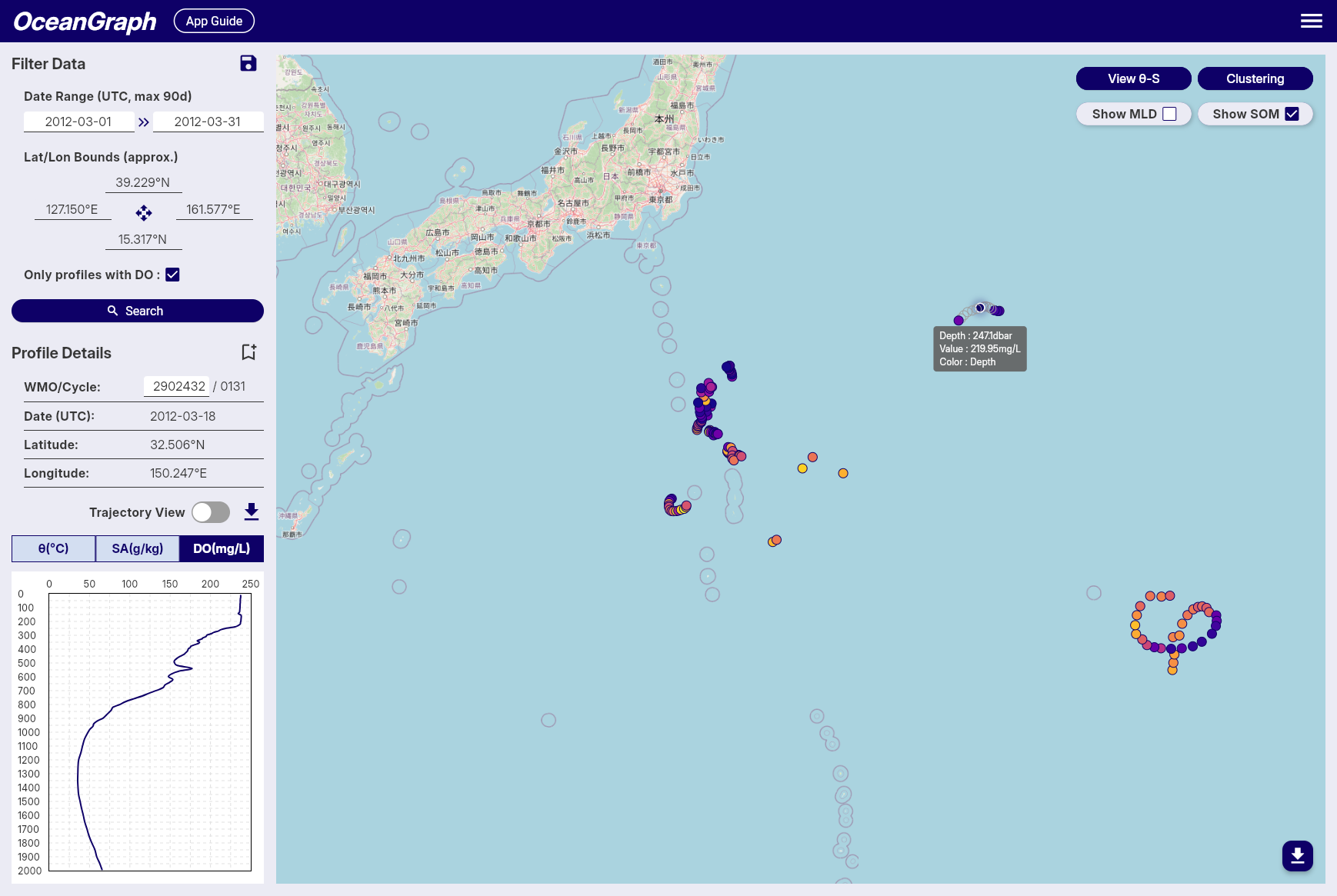
Use SOM
SOM is available to signed-in users and requires dissolved oxygen data.
- Search for profiles; use Only profiles with BGC to focus on BGC observations.
- Open Data layer in the map command bar and choose SOM. On narrower layouts, open Map tools first.
- Compare SOM pressure and oxygen values in marker tooltips.
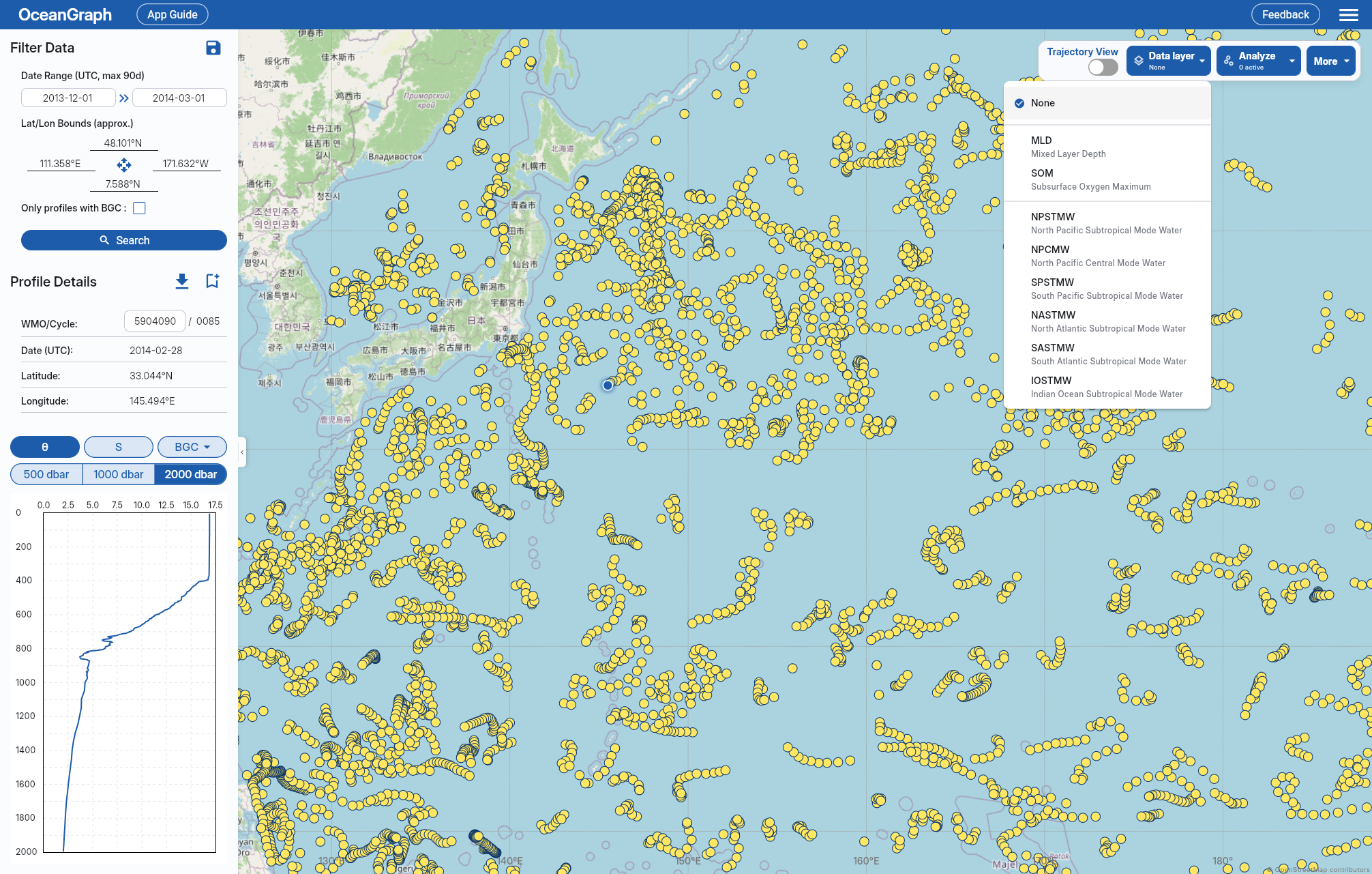
MLD, SOM, and mode water coloring are mutually exclusive. Profiles without oxygen or a valid SOM are shown as no-data markers. On an oxygen section, valid points are connected only across consecutive profile cycles. Gaps indicate a missing cycle or a profile where SOM was not detected or could not be calculated.
Detection
- With a valid MLD, candidates must be deeper than MLD and no deeper than 300 dbar. Without MLD, the range is 30–300 dbar. Profiles with MLD at 300 dbar or deeper are not assigned SOM.
- Detection uses finite source oxygen observations after quality masking and numeric-range checks. Internal gaps are interpolated only to evaluate peak shape; downloaded Profile JSON is not filled.
- A candidate must be an observed local maximum with at least 5 µmol/kg prominence and enough observed support around the peak. Endpoints, monotonic profiles, weak or unsupported narrow peaks, and peaks created only by interpolation are not reported.
- Candidates are ranked by prominence, oxygen value, then shallower pressure. When MLD exists, a supported peak within 100 dbar below MLD is preferred when available.
The result stores pressure in dbar and dissolved oxygen in µmol/kg. If no candidate satisfies the criteria, SOM is undefined.