Salinity and Temperature in the Ocean Explained
If you are learning oceanography, one of the first conceptual hurdles is understanding the relationship between salinity and temperature in the ocean. These two variables appear everywhere: in vertical profiles, in water-mass descriptions, in density discussions, and in T-S diagrams. Yet beginners often encounter them separately before they understand why they have to be interpreted together.
That creates a common problem. You may know that warm water is different from cold water, and that salty water is different from fresh water, but you may still not know how those differences combine to shape the ocean.
This guide explains how salinity and temperature are related, why both matter for ocean structure, what common patterns look like in real profiles, and how to explore those relationships in OceanGraph using Argo data.
If you want the profile-reading foundation first, see Ocean Temperature and Salinity Profiles Explained.
Why Temperature Alone Is Not Enough
Temperature is intuitive, so many beginners naturally focus on it first.
That is useful, but incomplete. In the ocean, the behavior of seawater depends on both:
- How warm or cold it is
- How salty or fresh it is
Two water parcels can have the same temperature and still behave differently if their salinity differs. The opposite is also true: two waters can have similar salinity but different thermal structure.
This is why oceanographers almost never stop with temperature alone when interpreting water masses or vertical stability.
What Salinity and Temperature Each Tell You
Temperature often reflects:
- Surface heating and cooling
- Seasonal changes
- Vertical stratification
- Contact with deeper or shallower water
Salinity often reflects:
- Evaporation
- Rainfall
- River input
- Ice melt or sea-ice formation
- Mixing between different water types
That means the two variables respond to overlapping but not identical processes.
When you read them together, you get a more complete view of what shaped the water column.
How They Affect Seawater Density
One of the main reasons salinity and temperature are always discussed together is density.
In broad terms:
- Colder water is usually denser than warmer water
- Saltier water is usually denser than fresher water
This matters because density influences:
- Vertical layering
- Mixing
- Stratification
- The identity of water masses
In practical interpretation, this means you should not ask only whether a layer is warm or cold. You should also ask whether its salinity reinforces or offsets that temperature effect.
For example:
- Warm water can still be relatively dense if it is salty enough
- Cool water can be relatively light if it is fresh enough
That is why a T-S or θ-S diagram is often such a useful next step after reading vertical profiles.
The Relationship Is Not a Single Rule
Many beginners expect a simple relationship such as:
- warmer means fresher
- colder means saltier
The real ocean is more complicated.
Sometimes temperature and salinity move together. Sometimes they move in opposite directions. The pattern depends on the physical process involved.
Here are a few common cases.
Surface heating
If the ocean surface is heated strongly, the upper layer often becomes warmer. But heating by itself does not automatically change salinity.
So the result may be:
- Warmer surface water
- Little salinity change at first
If the warm surface is also separated from the water below, stratification may increase.
Evaporation
Evaporation removes water and leaves salt behind.
That often leads to:
- Warmer surface conditions in sunny regions
- Higher salinity at the surface
This is one reason some subtropical surface waters are both warm and relatively salty.
Rainfall or river input
Freshwater input lowers salinity.
That often leads to:
- Fresher surface water
- A stronger salinity gradient with depth
If rainfall occurs in a warm region, the surface may be warm and fresh. In that case, temperature and salinity tell different parts of the story.
Cooling and winter mixing
Surface cooling can make the upper ocean denser and more likely to mix.
This can produce:
- Cooler surface water
- A deeper mixed layer
- More vertically uniform temperature and sometimes salinity
The key point is not that cooling creates one fixed salinity pattern. The key point is that temperature changes can alter how the upper ocean mixes.
Mixing between water types
Sometimes the most important relationship is not local forcing at the surface but mixing between different water masses.
Then the observed salinity-temperature pattern may reflect:
- Warm salty water mixing with cooler fresher water
- Surface-modified water mixing with deeper water
- Regional water-mass contrasts
This is where T-S space becomes especially useful.
Common Ocean Patterns
Although there is no single global rule, some recurring combinations appear often.
Warm and fresh surface water
This may occur where heating is strong but freshwater input is also important.
Possible causes include:
- Rainfall
- Runoff
- Ice melt
The water may look warm in temperature alone, but salinity reveals that the surface layer is also distinct in composition.
Warm and salty surface water
This is common in regions where evaporation is strong.
Here, temperature and salinity can both contribute to a distinct surface water type, though their effects on density work in opposite directions.
Cool and fresh water
This pattern often appears in higher latitudes or where freshwater input is large.
It can indicate:
- Surface cooling
- Meltwater influence
- Strong seasonal or regional contrasts
Cool and salty water
This can appear where cooling and salt addition both matter, or where deeper waters have different formation histories than the surface.
It often points toward denser water and a different dynamical role in the water column.
Example 1: Same Temperature, Different Salinity
Imagine two near-surface samples with similar temperature but different salinity.
If you looked at temperature alone, you might think they represent similar conditions. But if one sample is much fresher, the interpretation changes immediately.
That difference may suggest:
- Rainfall or runoff influence in one case
- Different regional water masses
- Different density structure even at the same temperature
This is a simple example of why the relationship between salinity and temperature matters more than either variable by itself.
Example 2: Same Salinity, Different Temperature
Now imagine two waters with similar salinity but clearly different temperature.
That may reflect:
- Seasonal heating or cooling
- Different depths within the same region
- Different atmospheric conditions over time
Again, looking at one variable alone would compress a physically meaningful difference into something that looks too simple.
Why Vertical Profiles Matter First
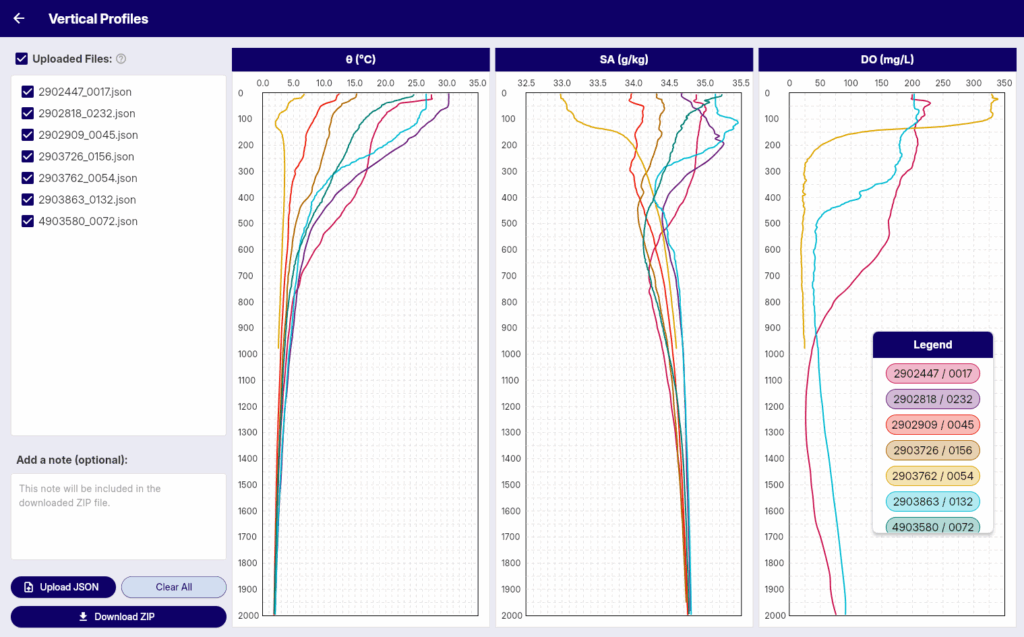
For most beginners, the easiest way to understand this relationship is to start in profile space.
A vertical profile shows:
- Where the warm or cool water sits
- Where fresher or saltier layers appear
- Whether the main gradients occur at similar depths
- Whether the deeper water is stable or changing
This helps answer the first practical question: where in the water column are the important differences?
OceanGraph’s guide for this workflow is here:
Why a T-S Diagram Makes the Relationship Clearer
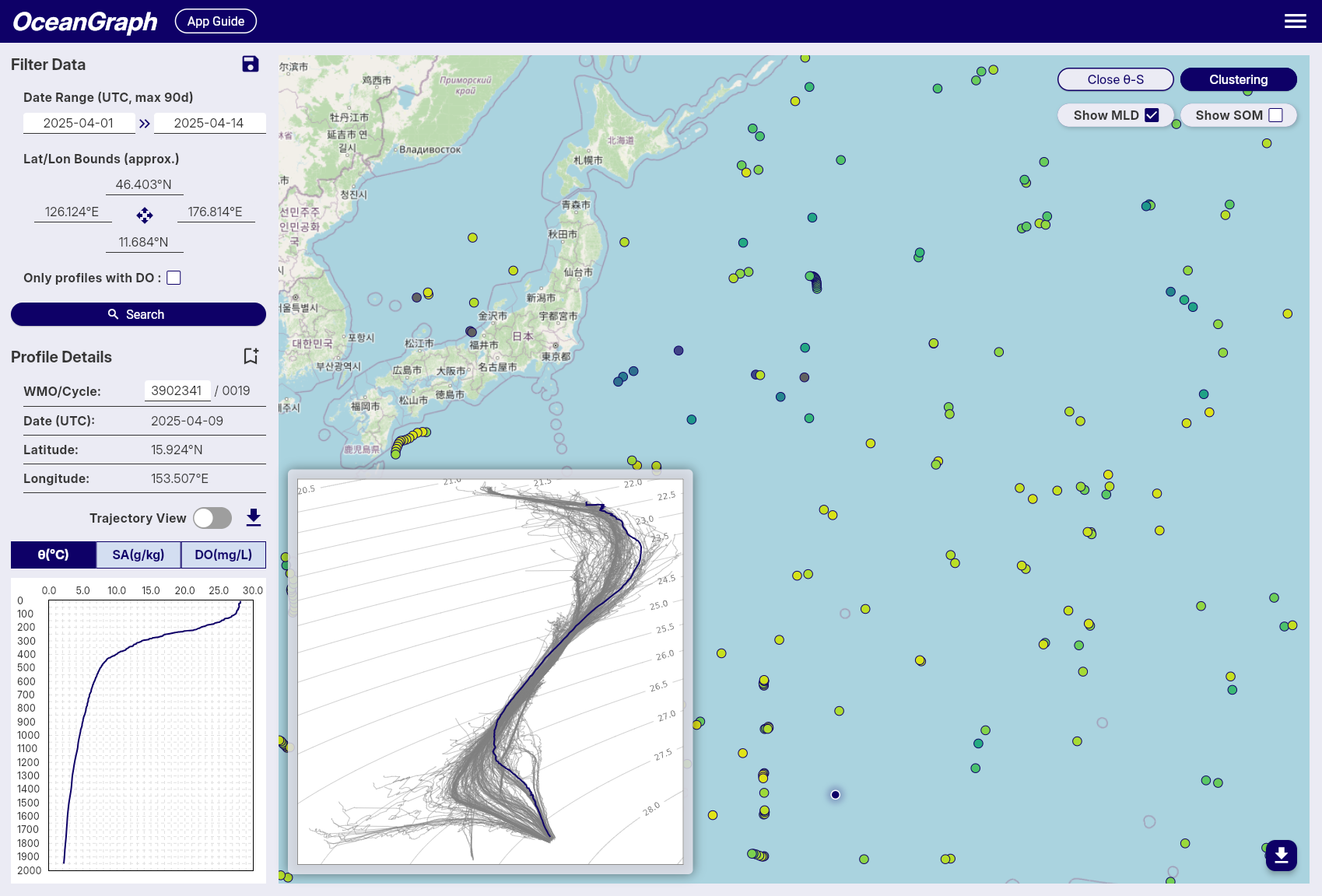
Once you understand the vertical profiles, the next step is often a T-S diagram or θ-S diagram.
That view is useful because it shows:
- Which temperature-salinity combinations occur together
- Whether the water column forms a smooth curve or distinct clusters
- Whether the structure suggests mixing between end-members
- How temperature and salinity combine in a way that relates to density
This is where many learners finally see why the relationship matters.
Instead of reading temperature and salinity as two separate lines, you read them as one connected water-property structure.
OceanGraph’s feature guide is here:
Common Beginner Mistakes
Several misunderstandings show up repeatedly.
Treating salinity as secondary
Salinity is sometimes treated as an extra variable that confirms temperature. In reality, it often changes the interpretation completely.
Expecting one universal relationship
There is no single global rule that links salinity and temperature in the same way everywhere. The relationship depends on region, season, forcing, and mixing.
Ignoring density
The reason these variables are paired so often is not arbitrary. It is because their combination strongly affects density and therefore the vertical structure of the ocean.
Reading profiles separately and stopping there
Profiles are the right place to start, but they are not always the best place to stop. A θ-S view often reveals the relationship more directly.
The Traditional Workflow: Learn the Concept, Then Write Code
A common learning path is:
- Read a textbook explanation of temperature, salinity, and density.
- Download profile data.
- Write code to plot temperature and salinity separately.
- Build a T-S plot later if time permits.
This path works, but it often delays intuition.
Many learners spend a long time understanding the plotting workflow before they get a clear feel for the actual salinity-temperature relationship in real observations.
A Better First Step: Compare Real Examples Interactively
Before writing code, it helps to compare several real profiles and then open a θ-S view of the same data.
OceanGraph is useful here because it lets you:
- Search real Argo profiles by region and time
- Compare temperature and salinity structure in the water column
- Move directly to θ-S space for the same observations
- Build intuition from multiple examples instead of one isolated figure
Useful follow-up pages are:
Explore the Relationship in OceanGraph
If you want to move from abstract definitions to real ocean structure, the next step is to compare profiles and open a θ-S view of actual Argo data.
Try with real Argo data -> OceanGraph
Explore profiles interactively
OceanGraph makes it easier to see how salinity and temperature work together instead of learning them as separate concepts.
Frequently Asked Questions
Is salinity or temperature more important in the ocean?
Neither is universally more important. Their combined effect matters most, especially when you are interpreting density and water-mass structure.
Does warm water always mean low salinity?
No. Some warm waters are fresh, and others are quite salty. The answer depends on processes such as evaporation, rainfall, runoff, and mixing.
Why do oceanographers always pair salinity with temperature?
Because the combination is more diagnostic than either variable alone. Together they help identify water masses, stratification, and density-related structure.
What is the easiest way to study the relationship?
Start with vertical profiles, then use a T-S or θ-S diagram. That sequence usually makes the relationship much easier to understand.
Do I need Python to compare salinity and temperature?
No. Python is useful for custom analysis, but you can build intuition faster by comparing real profiles and θ-S structure interactively first.
Conclusion
The relationship between salinity and temperature in the ocean is not one simple formula. It is the result of multiple processes acting together across depth, time, and region. That is exactly why both variables matter so much in oceanography.
The fastest way to understand that relationship is to compare real examples, read the profiles in context, and then inspect the same water in θ-S space. That is where OceanGraph becomes useful.